
When anxiety, depression, or obsessive compulsive patterns interfere with daily life, it feels heavy and isolating.
Cognitive Behavioural Therapy (CBT) is one of the most researched forms of psychological interventions. There have been decades of studies and hundreds of clinical trials that has proved its effectiveness.
It is used to treat many different mental health concerns, including anxiety, depression, phobia, panic, eating disorders, substance use disorders, impulse control disorders, and Obsessive Compulsive Disorder (OCD). It can also be used to treat many other struggles.
Cognitive Behavioural Therapy (CBT) is an evidence-based approach that helps clients understand their thought patterns (cognitions), emotional reactions and behaviours. Once understanding occurs, they can make meaningful change. CBT is a modality used by many of our clinicians.
How Does it Work?
Cognitive Behavioural Therapy (CBT) is based upon the principle that our thoughts, our feelings and our behaviours are deeply connected. They constantly influence and interact with one another. By understanding these connections and interactions, clients learn to notice patterns, challenge unhelpful thinking, and make meaningful changes in their lives and relationships.
With Cognitive Behavior Therapy (CBT), there are 3 levels of cognition:
Conscious Thoughts:
These are our rational thoughts. They are the deliberate choices that we notice and reflect on.
Conscious thoughts give us the opportunity to plan, problem solve, and respond with intention, rather than reacting impulsively.
Example: “I’m nervous for the presentation. However, I’ve prepared my speech and will practice beforehand to feel more confident”.
Automatic Thoughts:
These are our quick, often unconscious thoughts that may not be fully accurate or helpful.
Example: You start a new project or hobby, and aren’t the best at it (yet!) but you say to yourself “I’m terrible at this!!”.
Automatic thoughts can trigger emotions and behaviours before we even realize it! This is why gaining awareness, identifying them and then challenging them is a key component to CBT.
Schemas:
These are deeply held beliefs or personal rules that shape how we perceive experiences and respond to the world around us.
Example: “I must put others first”, “I can’t trust anyone”.
Schemas are often developed from early life experiences. They influence the way our brains process information, make decisions, and relate to others. Identifying and reshaping unhelpful schemas can create long lasting change. It helps to respond to life with greater emotional flexibility.
By exploring conscious thoughts, automatic thoughts, and schemas, CBT offers a clearer path for clients to gain understanding of their minds while disrupting unhelpful patterns, and cultivating healthier ways of thinking and responding.
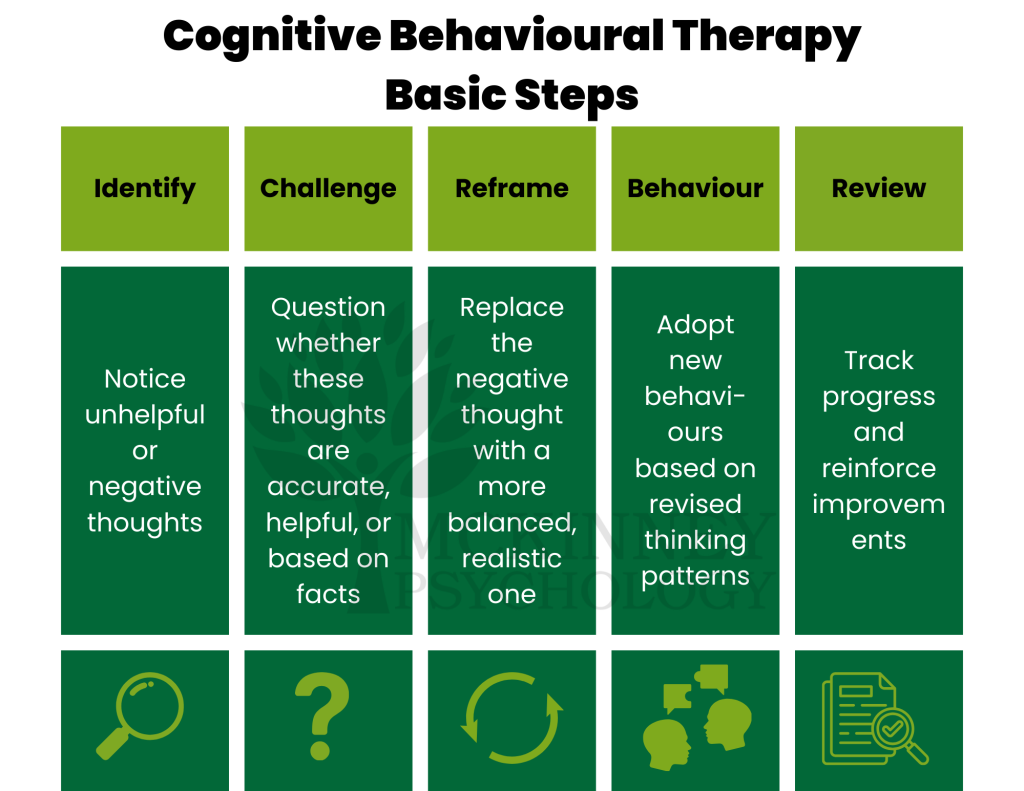
With CBT there are 5 Steps to Implementation
- Identify – The first step is gain awareness and notice the unhelpful or negative thoughts.
-
Challenge – The next step is to challenge these thoughts. Question if they accurate, helpful or based on facts.
-
Reframe – Following that you would replace the negative thought with a more balanced, realistic one.
- Behavior Change – Based on the revised thinking, new behavior is adopted.
- Review – Tracking the progress is the final step. We want to practice and reinforce the changes in thinking and behavior.
It is important to be patient as these changes occur. These thoughts and behaviours often took years to develop. It may also take a long time to break these thinking habits.
Who can benefit from CBT?
CBT is one of the most researched forms of psychological intervention. There have been decades of research and hundreds of clinical trials that has examined it’s effectiveness across many different mental health concerns, including anxiety, depression, and OCD.
CBT is typically considered a talk therapy used in Individual Counselling. Thus it is tyically used for clients with adequate language skills. It can be used for children and teen theapy, it is often used in Individual therapy with adults, in addictions counselling trauma therapy, and in couples therapy
Research consistently shows that CBT can significantly reduce symptoms of depression, anxiety disorders, obsessive compulsive disorder (OCD), and other mental health concerns.
CBT is also be used to treat these concerns :
- Sleep Disorders
- Post Traumatic Stress Disorder (PTSD).
- Substance use disorders
- Mood and Bipolar disorders
- Eating disorders
- Autism Spectrum Disorder
- Perfectionism
- Panic disorder and phobias
- Negative self-talk
- Poor Self Esteem
- many others.
Changing the way we think and respond to challenges takes time, but cultivating meaningful change is possible! CBT helps people learn new ways to understand their thoughts, manage their emotions, and respond to challenges more effectively. Reaching out for support is a very powerful step toward building healthier patterns and improving your overall wellbeing.
Participate in Cognitive Behaviour Therapy (CBT)
At McKinney Psychology, we have many clinicians that are trained in CBT approaches. It is the core foundational approach used by the founder of McKinney Psychology, so it is integrated in most aspects of our care.
If you or a family member are seeking support, we welcome you to connect with our team today to get started. Support is available. You don’t have to navigate this alone.